Monday, October 17, 2005

Cornershots


I'm still getting familiar with all the "photo urbanologists" out there, and there are a lot of great ones. I just discovered Cornershots (via Brownstoner), which has some really beautiful pics of NYC, a lot of them taken at night. This was taken of the Verrazano-Narrows Bridge recently. I'm adding links at right as I find these sites.

Thursday, October 13, 2005

Duck, Schmuck

New York just isn't complete until we can offer tourists the ability to cruise around in a tour bus that also doubles as a float. The Times reports:

Unlike Boston, Philadelphia, London and dozens of other cities around the world, New York City does not offer tourists the pleasure of paying around $25 to cruise the streets in an amphibious bus, known as a duck, that ends its journey by splashing into the nearest body of water.

I heard a stat recently that 1 out of 4 Americans have visited New York since 9/11, an amazing number if true. Does it seem like they were lamenting that we don't have an amiphibious bus? After 40 days and 40 nights of rain, I'm thinking it's New Yorkers who need them to navigate the city's streets not the waterways.

Photo by Robert Spencer for the Times.

Mr. Mayor, Do the Right Thing

The Times has a piece about Mayor Bloomberg promising to be more involved with the World Trade Center site if he’s re-elected. I had a post on Polis not too long ago that Mayor Bloomberg – whose re-election is all but assured – should not just “be more involved” in the WTC site, but should:

  • Instruct Deputy Mayor Daniel Doctoroff to revive his land swap idea in order to take full control of the WTC site (read more about that here)
  • If that fails, go the state when Pataki is out of there and demand that the land be condemned for public use.

To quote Paul Goldberger from his book, Up From Zero:

After all that happened in the aftermath of the terrorist attacks and the destruction of the most powerful symbol of the American skyline, it is hard to believe that the public would have objected to the decision to take over these sixteen acres of land for public purpose …

As I said before, Mayor Bloomberg has a golden opportunity to create a lasting legacy far more meaningful than a football stadium. With Pataki out of there, Bloomberg could and should assert himself as the dominant force at Ground Zero, even if the Governor has more power on paper. Without directly insulting Pataki, he could quietly but forcefully redirect the planning process, which I'm quite sure would garner a lot of public support. From previous statements, Blooomberg has demonstrated that he has the right instincts about what needs to happen there, which is to create a lively neighborhood that also respects the lives that were lost. And with sixteen acres to work with, this is entirely doable, so long as absurdly unnecessary office and retail space isn’t forced into what has the potential to become the most inspiring rebuilding effort the world has ever seen.

Related Times link: Mood Darkens on Rebuilding, Poll of Lower Manhattan Says

Wednesday, October 12, 2005

Hitherto Unknown Benefits of Good Urban Planning: Cruising Potential


Thank god for Curbed, or whomever slogs through a nearly 3300-word New York Observer piece about public cruising spots in New York, for digging out this fun tidbit:

High Line Architect: Get Your Cruise On

Yes, New York's recently ratcheted-up love affair with urban planning is producing a raft of mostly bland public spaces. But what does it mean for the gays? In this week's Observer, Choire Sicha speculates.

Read the whole thing, if only so you'll never look at the High Line quite the same way again—especially after this quote from architect Charles Renfro: "While it may sponsor gay cruising, I think it will also sponsor straight cruising and a general sense of pleasure that few public spaces in New York provide at this moment."
· The Great Gay Outdoors [Observer]

Note to Observer editors: Just make a bullet point list of the cruising spots with the funny supporting quotes, the way Time Out would, and maybe someone other than a Curbed intern will read the paper.

P.S. Is it just me, or does that illustration look more like stalking than cruising?

Tuesday, October 11, 2005

Urban Ruins


Gothamist found some great photos of the boat graveyard on Staten Island on Opacity, a photography website about urban ruins that the artist has explored. The guy who runs the site lives in Brooklyn, so I presume a lot of the places he has explored are in and around New York City. Here's an excerpt about his fascination with urban ruins:

This is a lonesome alien world whose dark corners and peeling walls have gotten a hold of me and many others; this affinity for derelict structures and often dangerous excitement is the core essence of urban exploring....

The boat graveyard is but one of many cool and creepy places Opacity has been photographing since 2000, including abandoned state hospitals (click to enlarge the two pics below). Click here for main page. There are more than a 1,000 photos on this website, so you can click here to scroll through the photographer's faves.


Monday, October 10, 2005

How to Build a Skyscraper

For those of you interested in the intricacies of how to build a world class skyscraper, New York Times VP David Thurm spells it out in the Harvard Business Review. Lesson Numero Uno: educate yourself and become the co-project manager. Lesson Numero Dos: Don’t fall for BS like “value engineering.” Lesson Numero Tres: Get manufacturers to make cool shit just for you on the cheap because you’re the Times. Lesson Numero Catorce (oops, I mean Cuatro): Involve the underlings in a meaningful way.

In all seriousness, if the Times builds its building the way Mr. Thurm says it is, Renzo Piano's tower will become an icon in the New York skyline in a way that none of the Times' previous buildings have.

Irreverent Commentary for Sale


East Harlem artist De La Vega, as I mentioned in a previous post, opened a store on St. Marks Place that sells his original artwork, as well as t-shirts and post cards with sayings like, "I just bought real estate in your mind." I dig his sense of humor. This pic was taken in front of his store over the weekend (apologies about the quality, it was taken with my cheap camera phone).

The Real Bilbao Effect

Architecture critic Nicolai Ouroussoff had a piece in yesterday’s Times about New Orleans, and it is a piece everyone should read, because its not just about New Orleans, but about America’s failure to invest in its cities. Just as urbanism is making a resurgence, we have neglected the very foundations on which cities exist. Meanwhile, countries in Europe and Asia have been investing in major public works projects the way America used to. Ouroussoff points out that Bilbao didn't just build a museum, but a brand new high-tech subway system. Meanwhile, in New York City, we can’t even finish a section of the subway line that was started four decades ago. Worse, what infrastructure we do have is slowly rotting before our eyes … actually, it’s not before our eyes, and that’s part of the problem. If we were confronted on a regular basis with our rotting infrastructure, we might be a little more inclined to insist that our government do something about it. The only real exception to this lack of investment that I know of is Chicago, where five-term mayor, Richard M. Daley, has invested a huge amount of time and money into mundane infrastructure improvements like rebuilding the waste water system, saving the city millions of gallons of water lost from leaks. Most mayor’s don’t have that kind of time or political capital to invest in such unsexy projects because they don’t exactly make headline news, and when it comes to putting city money up for big projects, when you’re dealing with limited resources, most all politicians will opt for the splashy project over the mundane but necessary one. I recall historian Mike Wallace calling for a New Deal for New York a few years ago and thinking, “How quaint. Nice try, but not gonna happen.” Now I think, not just for New York, but for America. The time is right for people to start demanding it.

Saturday, October 08, 2005

2 Good 2 Be 4 Gotten


When I saw that the AIA was kicking off the 3rd Annual Architecture Week in New York City with the first public presentation of plans to revamp 2 Columbus circle, I predicted here on Polis that shit would hit the fan. And sure enough, The Real Estate was there and took photos:

…today’s event at the Center for Architecture presented an up close battle of ideas over what to do with Edward Durrell Stone’s iconic structure. Sign-waving, brown-bag protestors paced the sidewalk, while in a sleek, downstairs auditorium, architect Brad Cloepfil gave the first public presentation of the much-debated 2 Columbus Circle design. Rick Bell restated the position of the A.I.A., that the case should not be brought before the Landmarks Commission.

The Lollipop building has been the subject of eight lawsuits brought by Landmarks West trying to stop the Museum of Art and Design from changing the façade. I’m kind of agnostic on this fight, but I have to disagree with Tropolism who 1. equates preservationist efforts to save the building with earlier efforts to save a parking garage on Charles St., and 2. chastises the preservationists by reminding them that 2 Columbus Circle sat empty and derelict for years. If that was our standard for preservation, how many treasures – that are now fully restored and put to good use – would have been leveled? Too many to count.

Rendering of new façade, left, as is, right.

Friday, October 07, 2005

The Truth Hurts

It's no secret that the International Freedom Center at the World Trade Center site, like Rafael Vinoly's THINK team lactice work towers, was single-handedly nixed by Gov. George Pataki. If rebuilding Ground Zero fails, the blame will fall directly on him. In today's Times, Richard J. Tofel, a principal in the defunct International Freedom Center, doesn't pull any punches:

"You're not going to have a living memorial in any sense of the word," he says of the revised memorial quadrant, where a 9/11 museum will replace the Freedom Center. "When it opens, everyone will come," he adds ... "but I think the real question is, will anyone not personally connected with it come twice? How will what is going to be put there stand the test of time? I don't think it will."

Me, neither.

Thursday, October 06, 2005

The New New Museum

The New Museum of Contemporary Art, currently located in far west Chelsea, has been planning a move to The Bowery for some time now. Just the announcement several years ago to erect the first new museum building in downtown Manhattan in over a century drew a smattering of galleries to the nabe, causing some to speculate that The Bowery will become the alternative art gallery destination (for more on that, click here). Today The New Museum announced a ground-breaking ceremony on Oct. 11 for their new building at 235 Bowery (between Stanton and Rivington), designed by Tokyo-based architecture firm Sejima + Nishizawa/SANAA. With all the scary condo buildings going up around there, this promises to be a lovely antidote. Rooftop terraces (and the rest of the museum) should be open in time for their 30th anniversary in 2007. Rendering of interior lobby and bookstore below (click to enlarge).


Photo by Christoper Dawson, drawings by Sejima + Nishizawa/SANAA.

Wednesday, October 05, 2005

In New Orleans, Let's Try New New Urbanism, Not Old New Urbanism

Another Floating House post from my new favorite arch-blog, Tropolism. As Chad Smith points out, this one is Dutch (as opposed to German, click here) and not only is the above image a real model, but some homes have already been built using this technology.

There are 37 houses strung along this branch of the Maas like a row of beads. At first glance, they seem quite unremarkable. Two storeys high, semicircular metal roofs and yellow, green or blue facades - hardly any clues let on that these are The Netherlands' first amphibious houses. The cellar, in this case, is not built into the earth. Instead, it is on a platform - and is much more than a mere storage room. The hollow foundation of each house works in the same way as the hull of a ship, buoying the structure up above water. To prevent the swimming houses from floating away, they slide up two broad steel posts - and as the water level sinks, so they sink back down again.

According to Bird to the North, an enormous urban design charrette for New Olreans is being organized by New Urbanists Andres Duany and John Norquist. I say, why don't we try some NEW new urbanist urban planning, something say, like floating neighborhoods. I'm serious. Read the full article here.

The Tortoise and the Hare

Redevelopment plans for the southern section of the East River Park to Lower Manhattan has commanded most of the media’s attention. The seemingly ubiquitous Gregg Pasquarelli of SHoP architects is involved, after all. But a little further north is a long-delayed and more pedestrian restoration project that has finally gotten underway. The waterfront walkway from 14th Street to the Brooklyn Bridge was closed off in 2001 due to dangerously unstable bulkheads. An eight-foot chain link fence went up and, well, you know the rest. But Gotham Gazette reports that recent activity has been spotted to restore waterfront access to the lowly people of the East Village and Lower East Side:

Some $54 million is going to the bulkhead construction. The actual building of the promenade with benches, plantings, and lights will cost $13 to $15 million. That part of the project is currently being sent out for bids.

Of course, no one expects the poor folks and the last of the bohemians on the East Side to get anything remotely like Hudson River Park. But a little waterfront access sure would be nice. Completion date is loosely estimated to be 2007 or 2008, but I guarantee it’ll be done sooner than the fancy-pants Lower Manhattan section (see image below).

Photo: Gotham Gazette, above; rendering of East River Park below by SHoP Architects.

Shop NYC

I stumbled across Emerge NYC several weeks ago and was surprised to find that this “mini-boutique mall” – featuring upscale hand-crafted clothes, bags, jewelry and accessories by up-and-coming designers – hadn’t garnered a huge amount of ink since it opened in early August. The people behind Emerge NYC – while smart and creative – aren’t exactly Barbara Corcoran-like publicity machines. But as soon as I walked into the Bleecker Street un-mall, I could tell this was a new and interesting retail concept. So I wrote a story about it for the Times. You can read the whole thing here.

Photo of Heidi O'Donnell, a clothing designer, at Emerge NYC in NoHo by Hiroko Masuike for the New York Times.

Tuesday, October 04, 2005

Trader Joe's, Better Late Than Never


I don't know how I missed the news that Trader Joe's -- after much speculation -- finally inked a deal to occupy the ground floor of NYU's Palladium building just off Union Square, especially since I reported the damn story myself for the Times when lease negotiations were still underway. But apparently, this has been a done deal since mid-September, according to NYU's own publication. Not familiar with SoCal grocery store chain Trader Joe's yet? As food writer and lovely individual Joanna Pruess told me for the Times piece: "You have the crunchy granola types and the foodies merging at Trader Joe's." I'm freakin psyched.

Addendum: Curbed has a way of posting items shortly after I've posted on the very same topic, and usually they have better info than I do (which happened twice yesterday, first with 2 Columbus Circle, then with my new favorite arch-blog Tropolism). So, for better, funnier, hipper, more complete info on Trader Joe's, click here.

Home Solutions for Global Warming

First the Loft Cube, then the Space Box, and now the Floating Home. From my newly discovered favorite arch-blog, Tropolism (blogger Chad Smith is a fellow Ohioan), we learn about the German company’s designs for Floating Homes: “They claim to have created a unique maritime structure that is neither house nor ship. Neither fowl, nor fish.” Tropolism also points out that the configurations can create some interesting water spaces, like a natural front yard pool. I'll refrain from making a snide crack about Katrina ... Hey, maybe the federal government can spend billions of dollars in New Orleans building these rather than warehousing the poor in no-bid mobile homes destined to become permanent slums. Seems like a better bang for the buck.

.

Superfly!

I’m a huge fan of the Times’ audio slide shows, and this one is not to be missed. Accompanying an article about Bronx photographer Joe Conzo, Jr., who captured hip-hop’s early days in New York City, is a fab audio slide show of his pics set to “Weekend” by the Cold Crush Brothers. Keep your cursor poised on the “pause” button so you can savor some of the photos.

Photo of Joe Conzo Jr. at his Bronx apartment by Suzanne DeChillo/The New York Times

2 Columbus Circle, I Think I Read Something About That...

The Third Annual Architecture Week at the Center for Architecture in New York kicks off with this event:

Thursday, 10/06/05, 3:00-5:00pm
The Museum of Arts & Design will present a preview of its new premises at
Two Columbus Circle. Allied Works Architecture is the architect for this transformation and renewal of the long-derelict building into a state-of-the-art, light-filled museum to house MAD's expanding collections and programs.

Hmmm. I seem to recall there was some controversy around the "lollipop" building. From today's Curbed:

The preservation battle at 2 Columbus Circle appears to be over, what with construction set to begin this week. Wait. What? Landmark West has filed its eighth lawsuit seeking to halt the Brad Cloepfil redesign? Lollipops for everyone!
· 'Lollipop' Building Set to Be Revamped [NY Times]
· 2 Columbus Circle Jerk? [Curbed]
· Court Clears Way for New 2 Columbus Circle [Curbed]

Good lord, The Center for Architecture is risking life and limb by opening its celebration week with this doozy of an event. Didn't they get the memo marked CONTROVERSIAL?

Housing Bubble, Part MCXLVII

Big story! The housing bubble is really bursting now. This time, for sure. From a lede story in the Times stating that the housing market has slowed in every hot market in the country:

In Manhattan, the average sales price fell almost 13 percent in the third quarter from the second quarter, according to a widely followed report to be released today by Miller Samuel, an appraisal firm, and Prudential Douglas Elliman, a real estate firm. The amount of time it took to sell a home was also up 30.4 percent over the same period.

Of course, we’ve been whipsawed by conflicting housing data for awhile now, so here’s the knock-out graph:

In another sign that the housing market might have reached a peak, executives at big home builders have sold almost $1 billion worth of company stock this year.

So there it is.

Monday, October 03, 2005

Idling at Zero

I just finished reading the updated paperback version of Paul Goldberger’s book Up From Zero: Politics, Architecture, and the Rebuilding of New York. Anyone remotely interested in understanding what has transpired there should read this book. Even though I’ve followed the events fairly closely, Goldberger’s running account not only reminded me of things I had lost track of, but provided invaluable insight into the conflicts, bad decisions and miscommunications that have plagued the rebuilding effort. As he concluded the hardcover version of the book, “Idealism met cynicism at Ground Zero, and so far they have battled to a draw.”

The book reminded me of how much hope there was at the beginning of the rebuilding process, and how that has been so shamelessly squandered. He quotes the initial “Vision Statement” of The Civic Alliance, organized by the Regional Plan Association, which said in part:

Lower Manhattan [can] show the way to a new urban future.

Is there anyone who can say with a straight face that we’re on the way to making that hopeful statement happen?

I had a post on Polis not too long ago pleading to re“think” the WTC rebuilding site, with a reference to Rafael Vinoly’s THINK team design of two open-lattice towers that mimic the Twin Towers. Governor George Pataki, who no one would argue is an architectural visionary, single-handedly nixed the THINK team’s striking proposal based on a gut reaction, which just goes to show how powerful even a rendering can be. It succeeds precisely because it is disturbing as a symbol of what was lost as well as how we will recover: Tall and proud yet never quite the same again. Goldberger's description of Pataki's reaction reminded me of the knee-jerk response to Maya Lin’s Vietnam Memorial, which surely never would have been built if the decision were up to one politician concerned about getting re-elected.


The Freedom Tower design – first proposed by Daniel Libeskind, the winner of the master plan competition, and then redrawn by David Childs of Skidmore Owings and Merrill – is an unqualified, abject failure. It is neither a good commercial office building, nor does it work as a symbol. It could be a skyscraper in Anywhere, USA, minus the bunker-like base to satisfy security concerns that can never be fully addressed unless we build a nuclear bomb shelter at Ground Zero and leave it at that.

As if there weren’t enough evidence that irony is most certainly not dead, as was claimed shortly after 9/11, the most recent disheartening development at Ground Zero is the demise of the International Freedom Center. It was nixed because people are scared of too much free speech taking place through exhibits that say something about oppression around the world. Maybe it was naive to think any real culture could thrive in such an atmosphere, but it’s another disappointment just the same.

What really needs to happen is this: Mayor Bloomberg needs to take the reins of the rebuilding effort. Period. With Pataki on the way out and the West Side Stadium dead in the water -- and Bloomberg’s re-election all but assured -- now is the time to start laying the groundwork for taking back this process for the people of New York.

Mayor Bloomberg could instruct Daniel Doctoroff to revive his brilliant idea to swap the land under the airports (which is owned by the city, even though the airports are run by the Port Authority), in exchange for taking control of the WTC site, which is owned by the Port Authority and leased to developer Larry Silverstein. There are clearly too many cooks in the kitchen with too many conflicting interests. The Port Authority and Larry Silverstein are insisting on maximizing profits from commercial and retail on the site, with everything else an afterthought.

If the land swap fails, then Bloomberg should go to the state when Pataki is out of office and ask that the state condemn the land for public use. As Goldberger points out in Up From Zero:

… as the events of September 11 were unprecedented in American history, so, too, should the response have been unprecedented. After all that happened in the aftermath of the terrorist attacks and the destruction of the most powerful symbol of the American skyline, it is hard to believe that the public would have objected to the decision to take over these sixteen acres of land for public purpose, and to use public funds to purchase the land from the Port Authority or to buy out Silverstein’s lease.

Mayor Bloomberg has a golden opportunity to create a lasting legacy far more meaningful than a football stadium. And the plans he announced two years ago to revitalize Lower Manhattan around the WTC site show that he has the right instincts about what needs to happen at the site itself, which is to create a lively neighborhood that also respects the lives that were lost there. With sixteen acres to work with, this is entirely doable, so long as absurdly unnecessary office and retail space isn’t forced into what has the potential to become the most inspiring rebuilding effort the world has ever seen.

Friday, September 30, 2005

San Gennaro Festival


I have a new photo essay on Polis, this one of the San Gennaro festival in Little Italy last weekend. There's a link at right or click here.

Silvercup Sunset


I took this shot from a roof-top party at Silvercup Studios in Long Island City last night. The party was celebrating the installation of the largest green roof in New York City on top of the studios where Sex and the City and the Sopranos was/is filmed. (I wrote about the green roof for the Times.) The sunset was spectacular (as was the party). Click the photo to enlarge, or click here to see four shots in a time lapse arrangement.

Unreal.

I'm all for political diversity, except in my neighborhood. So please, any misplaced red-staters asking for the removal of the above painting because it offends them need to get the hell out of the E.Vil. (from Curbed, which then quotes The Villager):

What better way to get going on a Friday morning than with a controversy over boobies? An argument over the display of the above painting in the window of an East Village gallery is easy fodder for those who decry the current state of the neighborhood as a yuppie playpen, but you'll be happy to know that there's at least one guy committed to keeping the East Village edgy:

In the week since the gallery’s curator put the painting in the window, several local residents have requested he remove it...

“What a bunch of nerds these kids are!” said Jesse Gee, the gallery’s curator, standing inside his store on a recent Friday afternoon.

Thursday, September 29, 2005

Art Meets Commerce in DUMBO

Opening tonight at the Wessel + O'Connor Fine Art gallery in DUMBO (through Nov. 5) is an exhibition of black-and-white photographs by Wouter Deruytter, who has spent four years shooting large-scale billboards around town. The photographs don't just capture the intersection of high art and commerce, but in fact ARE the intersection of high art and commerce. (They also depict jaded New Yorkers ignoring these outsized billboards at will.)

On a side note, the DUMBO gallery collective at 111 Front Street, Second Floor where the Wessel + O'Connor gallery is, has rather organically become a center for photography. I was going to write about it awhile back for the Times, but alas, I just couldn’t come up with anything new to say about DUMBO, even though the gallery collective itself is definitely worthy of ink.

Home-Ownership: Not Just for the Rich and Famous Anymore?

Continuing on the middle class housing squeeze, the Times has an interesting trend piece today about how programs to help middle income people buy homes have proliferated around the country. There are some good anecdotes in the piece, but with no attempt to quantify how many people have benefited or might benefit – not even in a single city where the programs have already been implemented – renders the article less than convincing. Nonetheless, here’s one program I find pretty encouraging:

Investment funds totaling $190 million have been created in the past year in Los Angeles and San Diego Counties for the purpose of building middle-income housing in so-called urban infill areas that have access to public transportation.

The funds' manager, the Phoenix Realty Group, expects to finance more than 3,000 homes in the next five years. As in many work force projects, the builders will be allowed to construct more units than typically permitted under zoning laws. The "density bonuses" enable the developer to make up the lost profit on each unit by selling more of them.

This strikes me as precisely the right way to go about providing home-ownership opportunities for middle income people: investment funds incentivizing developers to build higher-density housing around public transportation. This is killing a bunch of birds with one stone: reinvesting in urban cores, cutting down on the need to drive and consume gas, creating vibrancy and density to support further commercial investment, and hopefully relieving pressure on exurban sprawl.

The article doesn't report out what programs are being implemented in New York except to say that zoning variances have been offered to developers if they include moderate-income housing in their plans for Greenpoint and Williamsburg. That's like throwing a few bricks into the Grand Canyon.

Wednesday, September 28, 2005

My Hometown

A piece I wrote for the Times about Cleveland, my hometown, is a good excuse to break from my New York City musings here at Polis. On a more personal note, I grew up in Cleveland Heights, an inner ring suburb kind of like Montclair. I moved in and out of Cleveland several times, first to Northern California, then to D.C. and finally to New York with two tours of duty in Cleveland in between. The last time I left, I knew I wasn't ever going back for a whole host of reasons. But I remember feeling almost angry at my hometown for being so lame that I couldn't possibly stay -- despite the fact that my friends and family lived there, and I owned a house that I loved -- because the job market was so shallow and the city was nearly devoid of life. I had been an editor-in-chief of a weekly paper there and worked for a member of Congress who represented Cleveland, so I knew the place like the back of my hand and had deep connections with civic life. I do hope that Cleveland really does make a comeback, and not in a boosterish, PR-kind of way, but in real way. And I'm not one of those people who thinks that's impossible. Anyone in Cleveland who doesn't think it's possible should come to New York City and tour a few neighborhoods in Brooklyn that were all but left for dead 10 years ago. Things can and do change. It's a question of, for better or worse?
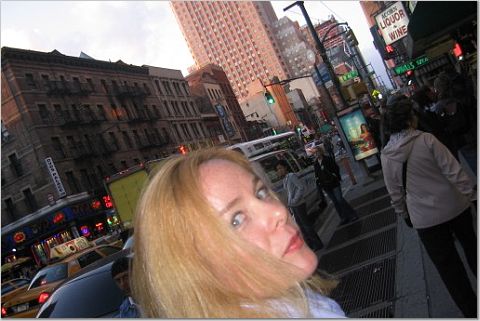
P.S. I took the above photo for the Times, and here's a link to a brief photo essay of downtown Cleveland.

Run-of-the-Mill-ion Dollar Apartment

A piece in today’s Newsday gets in on the "middle class is getting squeezed by housing prices" media jag. Wonder how those working class and poor folk are doing… but I digress:

For the first time, there are more than 1 million owner-occupied homes in the United States worth $1 million or more, according to a Census Bureau survey published late last month. … the king of outrageous housing prices continues to be Manhattan …The average price for an apartment in all but Harlem and the borough's northern tip climbed above $1.2 million in the second quarter of 2005, said Gregory Heym, chief economist for Terra Holdings, an owner of real estate brokerages in the city.

More Polis posts on the middle class squeeze:
To Be or Not To Be Broke
Gas Prices: What Goes Up Won't Come Down

Tuesday, September 27, 2005

The Sky's the Limit

Lewis Mumford argued many years ago that skyscrapers distort land-use costs. More recently, Paul Goldberger pointed out in Up From Zero: Politics, Architecture and the Rebuilding of New York, skyscrapers have rarely if ever been profitable and have always been about power and prestige. So, despite 9/11 and the uneconomics of building more than 80 stories high, they will continue to get built ever higher. ArchNewsNow has an interesting Q&A with Ron Klemencic, chairman of the Council on Tall Buildings and Urban Habitat, who is bringing together the world's tall building experts – specialists in technology, finance, and architecture – for the Council on Tall Building’s 7th World Congress, October 16-19 in New York City, themed “Renewing the Urban Landscape.” I’m not so sure there are many people who would argue that skyscrapers can “renew the urban landscape,” but then again, isn’t that what we’re trying to do with the “Freedom Tower”?

Rendering by Skidmore, Owings & Merrill: Burj Dubai, United Arab Emirates (the height is undisclosed but some experts put it at 2,313 feet)

Sorry Charlie

It seems wherever there are inflated egos, so must follow inflated prices. Until they pop. (Or is that hiss?) The Times is reporting that the fifth and final restaurant to round out the Time Warner Center’s constellation of outrageously expensive dining halls has collapsed under its own weight. The retail developer, Related Companies, has pulled the plug on Chef Charlie Trotter’s seafood spot that was 2 years in the making when the budget rose from $6 to $11.5 million “for what would not have been a formal restaurant although it was being designed by the noted architect Michael Graves.” This, of course, begs the question, what is a “not formal” restaurant? Does that mean an $11.5-million “casual” seafood joint? Correct me if I’m wrong, but I think Charley’s Crab already exists.

Monday, September 26, 2005

Fun With Floats

I’ve been ignoring the Floating Island that has gotten local bloggers all in a tizzy, but this is just too freaking funny. First from Curbed, and then the Times:

Conceptual Floating Art Meets Mocking Meta-Art
Robert Smithson's concept of a Floating Island -- a 30'x90' man-made island towed by a tugboat around Manhattan -- has, after three decades, become reality. Touted as the "anti-Gates," ... Smithson's Floating Island docked yesterday for the last time … conceptual art mash-up narrowly avoided.

From the Times article:

Approaching the [Floating Island] on its starboard side was a small motorboat, affixed to which was a replica of one of the saffron-colored gates created by Christo and Jeanne-Claude that dotted Central Park last winter. Captain Henry remembered "The Gates" and, putting two and two together, he worried that maybe the man in the motorboat was planning on boarding his little version of Central Park and planting a gate somewhere among the trees.